Nick Blunier - Common Roots Studio in Biddeford, Maine

Updated: Sep 2

It is an old four-window school bus covered in paint and graffiti, with sea creatures swimming across its exterior, business names worked into the artwork, solar power on top and a rooftop deck. Children have painted it. Adults have painted it. A graffiti artist has painted it.
And on a bright August morning in Biddeford, Nick Blunier is standing beside it, ready to talk about where it came from. The bus is colorful, strange and wonderfully conspicuous.
It also makes considerably more sense once you know Nick.
Because for much of his adult life, Blunier has been figuring out ways to get art into the hands of people who need it — children, students, adults with disabilities, musicians, emerging artists and people who may not yet have the confidence to call themselves artists at all.
Today, much of that work comes together at Common Roots Studio on Washington Street in downtown Biddeford. Inside, there is art everywhere. Paintings cover the walls. There are ceramics, photography, jewelry and sea glass. Live plants share space with driftwood. Hoodies hang nearby.

A large metal wolf's head is assembled from discarded pieces of metal, tools and even kitchen knives. Upstairs are instruments, working artist space and a recording studio.
It feels less like a traditional gallery than a place where somebody might walk through the door with an idea and find a way to make it happen. That's essentially the point.
"I love the business because it's constantly evolving and changing," Blunier said. "You never know what you're gonna get."
To understand how he built it, though, you have to go back to a college student who wasn't entirely sure what he wanted to do with his life.
From UNE to Psychology and Art
Blunier was born in Dayton, Ohio, in 1990 and moved to Dover, New Hampshire, when he was in fourth grade after his father's work brought the family to New England. He graduated from St. Thomas Aquinas High School in 2008 and enrolled at the University of New England in Biddeford, initially studying occupational therapy. Three years into the program, something wasn't quite clicking.
[Subscribe to BrickTides.com]
Blunier found himself increasingly interested in his psychology electives. While attending UNE, he also took a job as a behavioral health professional, despite having no background in mental health. One of his first assignments was working independently with a nonverbal 15-year-old boy. Blunier remembers bringing him into the community, including to a town hall where the teenager helped alphabetize index cards for new dog licenses.
The boy would often rock back and forth while repeatedly listening to the same episode of VeggieTales. But when approximately 50 cards were placed in front of him, something remarkable happened.
"He'd shut off the tape recorder and he would just boom, boom, boom, boom," Blunier remembered, motioning his hands back and forth.
Then he'd return to rocking and listening. Blunier's job was to check the work.
"He never made a mistake," he said. "And I was thinking, the brain is wild."
Something had grabbed him.
Blunier began thinking seriously about psychology. An advisor noticed how well he was doing in those classes and suggested another possibility: art therapy.
Blunier's reaction was immediate.
"That doesn't exist."
It did.
Blunier changed course, ultimately graduating from UNE in 2012 with a psychology major and an art minor. It wouldn't be his last pivot.

Building an Art Program at Sweetser
While in college, Blunier interned with ArtVan, a Brunswick-based nonprofit founded by licensed art therapist Jamie Silvestri. He would travel around in a painted cargo van, bringing free after-school art programming directly into underserved communities.
The idea stayed with him. Instead of building a program somewhere and expecting children to find transportation to it, ArtVan brought the program to them.
"I love the mobile aspect of it," Blunier said.
He also helped with programming closer to Biddeford and Saco, including at the former Joyful Harvest Community Center and the Saco Transition Program. After graduating from UNE, Blunier took a job at Sweetser in Saco. He started as an educational technician, supporting classroom teachers and working individually with students.
Eventually, he returned to school and earned his special education teaching certification. Then came another idea.
Sweetser didn't have an art program. Blunier wanted one.
"I really feel like these kids need an actual outlet," he remembered thinking. "Why not let me do this?"
Sweetser eventually gave him the opportunity to create the art program from scratch. Blunier had to meet educational standards, but he didn't see any reason the lessons needed to feel conventional.
If students needed to learn the color wheel, for example, he wasn't particularly interested in having them simply draw a circle and fill in the colors. Instead, he'd hand them templates of Air Jordans. Design your own sneakers. Just use the color wheel correctly.
One student presented a bigger challenge. He sat through class after class refusing to participate. "I hate art," Blunier remembers him saying. About 15 classes passed. Then something changed. The student liked the markers Blunier was using for a particular project — but didn't want to draw the
assigned image.
"What do you want to draw?" Blunier asked.
"Patriots logo."
"Go for it."
The student was confused. That wasn't the assignment.
"If you're using the supplies and you're following the steps, I don't care what the image is at the end," Blunier told him.
That exchange gets remarkably close to Blunier's philosophy about art.
"It's not about the end result so much as it is focused on the journey they take to get there," he said.
A student can arrive angry, sit down with a piece of paper and begin drawing. Blunier can sit beside him and draw, too. The defenses begin coming down. A conversation begins. Art becomes the doorway.

Common Roots Studio Biddeford Maine
Blunier was making his own art, too. His fascination with driftwood began while he was a UNE student exploring Maine's beaches with friends. One day he found a log that looked like a gnome's head.
His friends didn't exactly see the vision. Blunier did. He built a life-sized gnome, using part of a lobster trap for its body, discarded rope and other materials collected near the ocean. Its sunglasses were made from sea glass.
He still has it.
Then the driftwood pieces got bigger. He made sculptures and trees, piecing individual pieces together almost like a puzzle. Eventually, there was a practical problem. Blunier had accumulated a lot of driftwood.
"My roommates hated it," he said.
He needed somewhere to put it.
Around 2013, Blunier and three other UNE graduates rented a space above what is now Elements on Main Street in Biddeford. Initially, it was simply somewhere for them to work, make things and hang out.
Then people started walking in during Biddeford's art walks. Some wanted to buy the artwork.
"Oh my God, people want to buy our stuff," Blunier remembers thinking.
The group became an LLC. The little working studio had accidentally become a business.
A Year Traveling America in a FedEx Truck
At one point, Blunier closed the studio and did something considerably less predictable. He and three friends bought an old FedEx truck on Craigslist, converted it into a tiny home and traveled across the country for roughly a year. Blunier's black Lab, Milo, came too. They added solar electricity. They built their own solar hot-water heater. They even converted an old boat trailer into a towable greenhouse.
Their navigation system was refreshingly unsophisticated.
"We had a giant road atlas. We'd look on the map," Blunier said. "We'd say, there's some green. Let's go check that out."
In Austin, Texas, they heard about a river cleanup and volunteered. A television news crew arrived, became interested in the group from Maine and featured them in a story. People who saw the report subsequently invited them to park in their driveway for about a month, paid them for yard work and cooked meals for them.
Elsewhere in Texas, they found themselves at a tiny bar on a Thursday night surrounded by old cowboys carrying guitars, violins and mandolins. One person would begin playing and everyone else would join.
They had been told Willie Nelson occasionally showed up.
"We were thinking... what if tonight's the night?"
It wasn't.
Blunier also found temporary work at an Austin wax museum devoted to horror movies, where he learned techniques from a set designer. Even there, Maine somehow followed him. The museum had a traveling exhibit from Portland's International Cryptozoology Museum.
"I got a Yeti calling me right now," Blunier joked.
Eventually, something became clear.
"I just realized I wasn't a nomad. I needed home and I missed Maine."
He came back.
Common Roots Studio's Different Gallery Model
Common Roots Studio eventually landed in its current Washington Street location. Today, approximately 14 Maine artists display work there in a typical month. The arrangement is intentionally simple. Artists pay $50 per month and keep 100 percent of what they sell. Blunier doesn't take a commission.
"If I didn't make it, why should I profit off of that?" he said.
The $50 helps keep the doors open. But Common Roots offers something beyond wall space.
Blunier helps artists think about pricing, materials, business cards, logos, markets and where their particular work might sell best. Two young artists even have a corner where they're learning some of those same lessons.
Sometimes he advises an artist that Common Roots might not be the right market. A $400 original watercolor, for example, might have a better audience in Kennebunkport. That's okay. Blunier would rather make an introduction than pretend otherwise.
"Don't lose money where I've lost money," he said.
He has also watched artists meet inside Common Roots and begin collaborating outside it. And he knows the feeling he's trying to create for them because he remembers the first time a stranger bought something he made.
"It wasn't to a family member," he said. "It wasn't a family member buying something."
Someone had walked in, seen what Blunier saw in a piece, and decided they wanted to own it.
"That was like one of my first feelings of being like an actual — like feeling like an artist."
Now he gets to watch other people experience it.
The Community Art Bus
Years after riding around with Silvestri and ArtVan, the idea of mobile community art was still sitting in Blunier's head. Eventually he found the vehicle. A 1981 Chevy Express Cutaway appeared on Facebook Marketplace. It had once been a school bus. Another owner planned to turn it into a food truck and had already gutted it before deciding it was too small. Blunier bought it.
He took out a small-business loan and began looking for another way to support the project. Sponsorships became advertising, allowing businesses to support the bus and have their names incorporated into its exterior.
Then Blunier did something even better.
He brought the bus to a Biddeford Fringe Fest, parked it on a tarp and invited the community to paint it. Kids painted. Adults painted. Someone grabbed spray paint and a ladder. Later, his friend Dana, a graffiti artist, added sea creatures. Blunier and friends built out the inside, added solar power and constructed the rooftop deck.
A vehicle inspired years earlier by an art therapist bringing creativity directly into neighborhoods had
finally become Blunier's own Community Art Bus. It is now in its fifth year of programming.
What's Next for Common Roots Studio
Common Roots isn't finished.
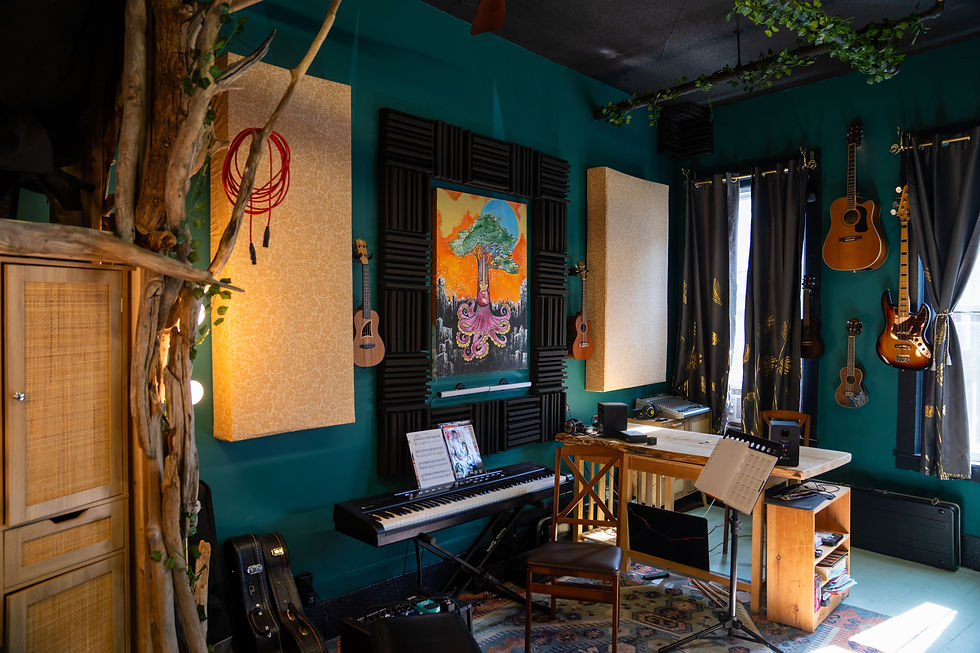
Upstairs, Blunier's longtime collaborator Pat — whom he first met years ago through the Saco Transition Program — teaches music. There is recording equipment and working artist space. Musicians have recorded there. A podcast has been made there. So has an audiobook. Blunier is painting murals now, too. He's developing a decentralized gallery concept that places rotating work by local artists inside other businesses.
And after all these years, the college student who once responded to the words art therapy with "that doesn't exist" is considering going back to school for a master's degree in exactly that. Sweetser, where he has now worked for roughly 15 years, offers tuition reimbursement. Blunier recently reached a service milestone that increases that benefit.
"Why not?" he said. "Now's the time."
Maybe that's the most appropriate next chapter for someone whose life has rarely followed a straight line.
Occupational therapy became psychology. Psychology found art. Art found Sweetser. Driftwood became sculpture. A room full of friends became a business. A FedEx truck crossed America. A former school bus became a rolling art studio. And a storefront on Washington Street became a place where painters, photographers, ceramicists, musicians, children and people who aren't quite ready to call themselves artists can find one another.
Blunier isn't getting rich from it. He still has his full-time job. When asked how Common Roots survives while charging artists so little, he doesn't pretend there's some secret formula.
"I have a nine to five and this is a passion project," he said.
But there are different ways to measure what a place produces. Sometimes five pieces sell during an art walk and they belong to five different artists. That's the outcome Blunier likes.
Sometimes someone who hasn't painted in months suddenly has a reason to make something again because there's an empty spot waiting on a wall. Sometimes a kid who insists he hates art picks up a marker and draws a Patriots logo.
And sometimes you have to take the art off the wall entirely, load it into an old school bus and bring it to them.
For Nick Blunier, that journey seems to be the point.
Many thanks to Nick for his time on Thursday, August 27th at Common Roots in Biddeford, Maine.
Visit Nick online: https://www.commonrootsstudio.com - And on Washington Street in Biddeford, Maine.
Nick is our 47th interview. Brick+Tides celebrates the people, places and businesses that give York County, Maine, its character — through original photography, thoughtful interviews and stories you might not find anywhere else. Each week, we sit down with someone from our community, listen to their story and share a little more about the popel who live, work, create and build things here.. If you enjoy discovering the people behind the places around you, subscribe to Brick+Tides and come along for the next story.