Frank Coletti : Coletti's Pizza


I’ve been gone a long time.
Twenty-five years.
Most of that time was in Orlando, where the pizza restaurants tend to feel interchangeable after a while—Ferrara's, Nona Street, Flame, Blaze—different names, same menus, same lighting, the same experience no matter which door you walk through.
I ate at all of them.
I never met the person whose name was on the sign.
Back in Biddeford, it feels different.
Some places are still there, but most aren’t. Names change, buildings change, and the way people talk about the city has shifted in a way that’s hard to define but easy to notice once you’re back inside it.
So I text a few Biddeford friends about the most important subject.
Where do I get pizza now?
[ Subscribe to Brick + Tides free weekly newsletter ]
A Name That Keeps Coming Up - Coletti's Pizza
One name keeps coming back.
Coletti’s.
It shows up again in a Facebook group, then again somewhere else, then again. Yelp. Google. The same name repeating across different places, not loudly, but consistently enough that it starts to feel less like a suggestion and more like a direction.
So I go.
Coletti's Pizza. 497 Elm Street. Biddeford.
Four Minutes
Inside, it’s already moving.
A phone rings somewhere behind the counter, someone steps forward to order, someone else waits without looking at their watch, and in the middle of it all is Frank—one hand near the oven, the other already reaching for the next thing before the current one is finished.
He talks while he works, his Italian accent carrying through everything without slowing the rhythm of the room.
“Four minutes,” he says. “That’s all you got.”
That’s how long a pizza takes, and he uses all of it—stepping out to greet someone, turning back to the oven, answering a question, moving again. It doesn’t feel rushed so much as continuous, like the pace isn’t something he’s forcing, but something he’s settled into over time.
Watching
Long before any of this, Frank was a kid in Naples, Italy, sent out to get pizza and choosing to stay longer than he needed to.
“My mom say, go make pizza,” he says. Not make it—go get it.
Instead of leaving, he would sit near the pizza maker, watching the way the dough moved, the way the fire behaved, the way everything seemed to happen in a rhythm he didn’t yet understand but wanted to.
“I sit next to the pizza guy,” he says. “I watch.”
They didn’t invite him into it.
“They look at you like, what are you doing here?” he says, laughing.
He stayed anyway.
“I remember the fire,” he says. “I keep thinking about it.”
Before This
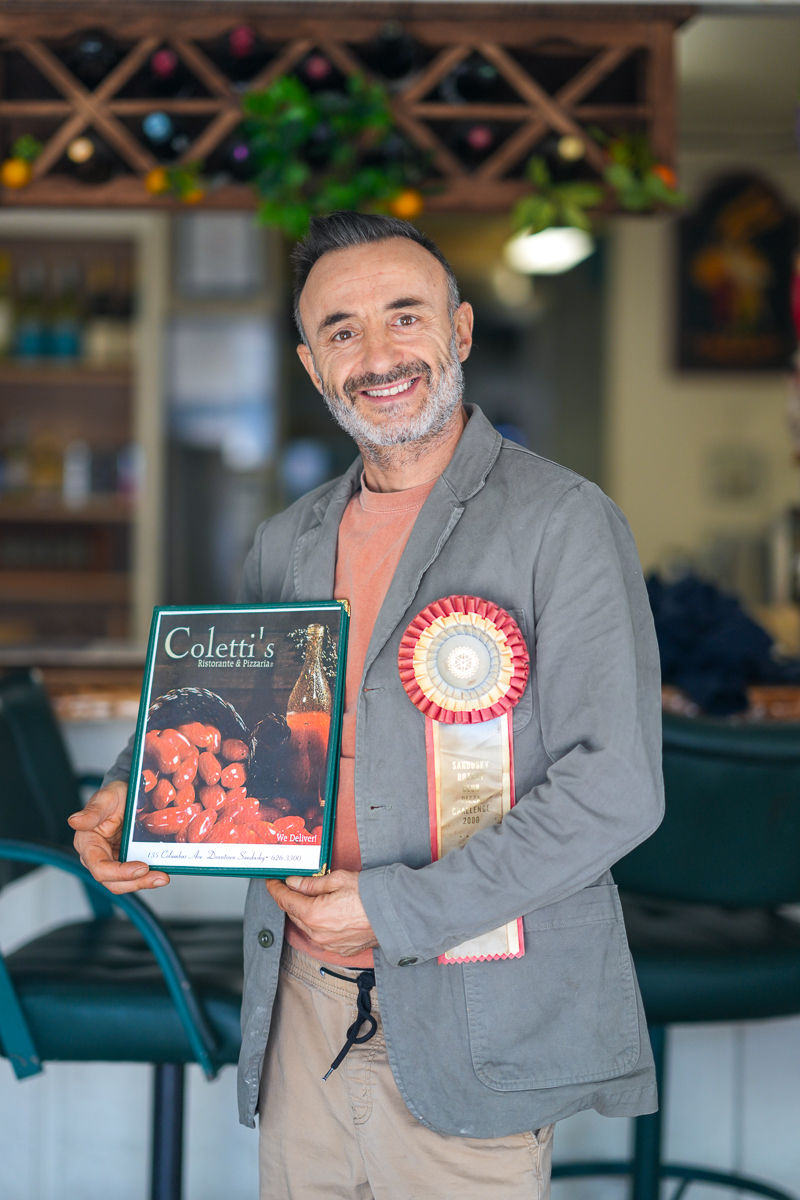
Frank came to the United States in 1994, at eighteen, by himself, without much of a plan beyond getting there and figuring the rest out once he landed. It was his first time on a plane.
“I was 18 years old, by myself,” he says. “Not knowing anything.”
“I was scared,” he says. “I thought I was going to die on the plane.”
He went to Ohio first, following a friend who said there might be work, but the job didn’t last and the plan changed immediately. Still, he didn’t leave.
“I was already here,” he says. “I say, don’t worry about it. We’ll find jobs.”
Within a few years, he opened his first pizza shop, despite having no real background in running a business and no reason, at least on paper, to believe it would work.
“I was only 23,” he says. “I didn’t know anything about business.”
It lasted five years.
Then it didn’t anymore.
There were more attempts after that—another shop, then a larger concept with dining and wine, each one a little different from the last.
“I had the feeling that nothing was working,” he says.
So he closed the bigger one, stepping away while he still could.
“I gave everything to my business partner,” he says.
That restaurant, also named Coletti's, is still open in Sandusky, Ohio.
Learning the Business
For a while, he stepped away from pizza and sold cars, working with Fiats and quickly becoming the top salesperson on the floor.
“I sold more cars than anybody,” he says. It’s not something he dwells on, but it shows up later in the way he runs the shop—how he talks to people, how he reads them, and how he understands the moment when someone is ready to say yes.
Pizza never really left, though.
“Everybody keeps talking about pizza,” he says.
After a few months back in Europe, where he says he began to remember “the way I was,” he returned to Maine with very little and started again.
“I started from zero,” he says. “I didn’t have anything left.”
Starting Over
He opened Coletti’s in April, 2016 with a few thousand dollars, building something small because that was all he could build at the time.
“The kitchen was like a hundred square feet,” he says. “One oven.”
He lived in the building then and worked alone, taking every order, making every pizza, answering every call, and figuring out how to keep everything moving without letting anything fall behind.
“One night I did 110 pizzas by myself,” he says. “You write the order, you make it, you answer the phone, you ring them up… everything.”
From the outside, it might look like survival, but the way he describes it, it feels more like a system taking shape—something built out of repetition, timing, and the understanding that four minutes, used correctly, is enough.
Reviews
As the shop started to gain attention, he leaned into something he had learned in sales but that most small restaurants still hesitate to do consistently—he asked.
“If somebody tells me, ‘This is the best pizza I ever had,’ I say, ‘In your life?’” he says. “Then I say, ‘Please, give me a review.’”
He didn’t offer anything in return, didn’t trade anything for it. He simply recognized the moment and acted on it.
Over time, those moments added up, and the reviews began to compound, eventually pushing the shop into a national ranking on Yelp in 2022. He was recognised by the company in early 2023.
“I came in number 31 in the United States,” he says.
He laughs when he says it, but by then the effect was already clear—more people finding the place, more people coming in because they had seen it somewhere, heard about it somewhere, or read about it somewhere.
Less
As the shop grew, the menu got smaller.
He keeps an old one from his earlier days, filled with options that once seemed necessary but now feel excessive.
“This is a mistake,” he says, pointing to it. “Too many things.”
What replaced it is something simpler and more deliberate, built around what works and what can be executed well, over and over again.
“You don’t need a hundred things,” he says. “You need the right things.”

His Father
At some point, he sits down, just for a minute, and gestures toward a few things on the wall that don’t immediately stand out until you know what you’re looking at—wine, a flag, a few art pieces that Frank painted.
“That’s my father,” he says.
His father was handicapped and had no use of his legs, but that’s not how Frank describes him, at least not in any way that defines what he could or couldn’t do.
“He fixed everything,” Frank says. “TV, washer, anything electronic… everything.”
People would come to the house and line up outside, not out of sympathy, but because they needed something repaired and knew he was the one who could do it, and Frank remembers watching them—watching the way they looked at his father, trying to understand how someone could work the way he did.
“They look at him,” Frank says. “They say, ‘How can he do that?’”
He grew up watching that, watching a man who didn’t move the way other men did still become the person everyone depended on, and that image seems to stay with him in a way that doesn’t need much explanation.
There’s a moment he comes back to, one that feels less like a story and more like something still happening.
The night he left Italy.
He didn’t have the money for a ticket, and his father borrowed it, not as a gesture of comfort, but as a condition.
“He say, ‘I buy you the ticket to the USA,’” Frank says. “He say, ‘I need you to promise me one thing. This is not for vacation,” his father told him.
“If you go, you go to make something.”
Frank nods slightly when he says this, like he’s still inside that conversation, like it never really ended.
Frank's father died a few years ago, but it’s not something he marks in a conventional way.
“I don’t even want to know the date,” he says.
“When I feel tired,” he says, “I think about my dad.”
His mother is still in Italy, and in contrast to that absence, there is something steady that remains. They talk every day. “FaceTime,” he says. “Every day.”
Ten Years
Ten years in, the place is still growing.
March 2026.
“We didn’t even celebrate,” he says. “We’re too busy.” Frank mentions double digit growth month after month.
Recently, he bought a house three minutes away, a shift that he says briefly and then moves past, as if it matters, but not as much as what still needs to be done.
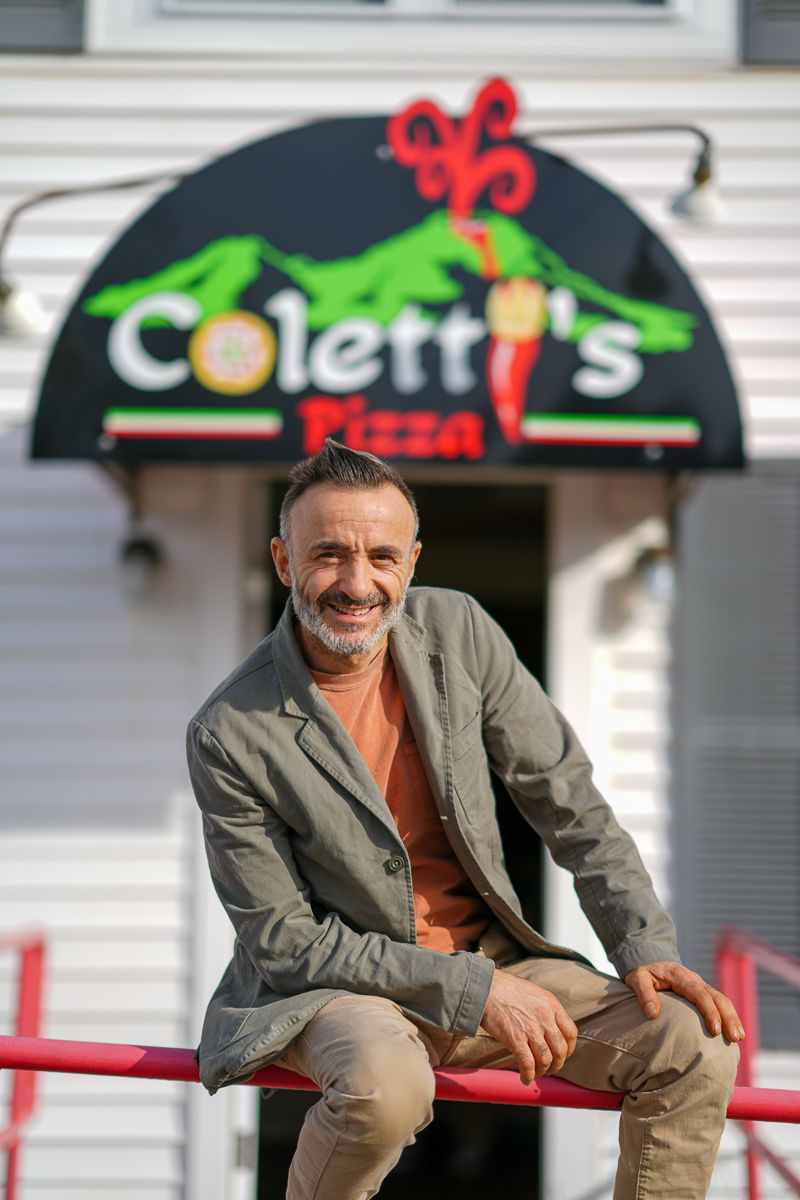
The Name
Out front, the sign hangs over the door.
Coletti's Pizza.
People come in because someone told them to, because they saw it online, because the name kept showing up in places they trust.
Inside, the phone rings again. Frank turns before it finishes. I know the name on the sign.
“Four minutes,” he says.
And goes back to work.
Congratulations on your 10 years of business, Frank!
Many thanks to Frank Coletti for his time on Monday, March 30, 2026 to sit down for this interview.
Visit Coletti's at 497 Elm Street, Biddeford, Maine.
Visit Coletti's website for hours and info.
Visit Coletti's on Instagram.
Coletti's Pizza Coletti's Pizza Coletti's Pizza Artwork at Coletti's Pizza A Portland Press Herald write up at Coletti's Pizza in Biddeford, Maine. Original Artwork by Frank Coletti. Original artwork hangs on the ceiling at Coletti's Pizza in Biddeford, Maine. Frank Coletti, owner of Coletti's Pizza in Biddeford, Maine on Monday, March 30, 2026. Frank Coletti, owner of Coletti's Pizza in Biddeford, Maine on Monday, March 30, 2026.