Krista Gagne - Maine Homestead


What began with cucumbers from her grandfather’s garden has grown into a Lyman, Maine, business producing approximately 100,000 jars a year.

Inside the Maine Homestead production facility in Lyman, two people stood beside a stainless-steel table, filling glass jars by hand. One person carefully ladled the contents from a large stockpot into each jar through a metal funnel, while the other placed and secured the lid.. Empty jars waited nearby, and rows of filled jars rested in red plastic trays.
I have seen Maine Homestead products in specialty food stores, gift shops, markets and even some gas stations throughout southern Maine. The name was memorable, the branding was polished and the products seemed to be everywhere. I assumed I would find machines.
Instead, I found people.
“You guys are the machines,” I told owner Krista Gagne as we watched the jars being filled.
Despite producing approximately 100,000 jars annually and selling through about 850 stores across the country, Maine Homestead remains remarkably hands-on. The pickles, jams, relishes and other specialty foods carrying the company’s familiar label are still made in Lyman, one batch and one jar at a time.
That human scale makes the company’s growth even more impressive. So does the fact that it all began with a plastic bag of cucumbers.
Maine Homestead Began With Her Grandfather’s Cucumbers
In 2011, Gagne’s grandfather arrived at her home with more pickling cucumbers than she could possibly eat. He had always maintained a garden, she said, but he was particularly interested in growing two things: pickling cucumbers and tomatoes. That summer, the cucumbers were plentiful.
“I knew that I wouldn’t eat them all, and I didn’t want them to go to waste,” Gagne said. “So I decided to try making pickles.”
She knew her grandparents liked bread-and-butter pickles, so she started there. Gagne had no canning experience, and few people around her were doing it at the time. To make her first attempt as foolproof as possible, she purchased a premade Ball spice mixture and followed the directions.
The pickles turned out well. More importantly, she enjoyed making them.
Soon, Gagne was gathering raspberries from her yard and turning them into jam. A family member had a pear tree, so she picked pears and experimented with those. She baked bread from scratch and continued trying new recipes.
At the time, Gagne was cleaning houses for a living. She would make jam and other products in the morning before leaving for work.
“I was just filling all of my bookcases and all of my cupboards with things,” she said. “I liked making it, but I wasn’t really eating it.”
She gave jars to friends and relatives until their shelves began filling, too. Eventually, she needed to find another home for everything she was making.

Selling Her First Jars in Kennebunk
That opportunity arrived in an email from The New School in Kennebunk, where Gagne had attended high school. The school was organizing a fall harvest festival and renting tables to vendors as a fundraiser.
Gagne decided to bring her canned goods and homemade bread. If nothing else, she reasoned, the table fee would serve as a donation to the school. Maybe people would be interested.
They were.
Gagne sold most of what she brought and received enthusiastic feedback from customers. It was the first
time anyone had purchased something she made.
From there, she signed up for every small event she could find during the remaining months of 2011. She sold at church craft fairs and at a tiny event inside a West Kennebunk fire station. She spent weekends beside longtime vendors, listening to their advice and learning how the craft-fair world worked.
By early 2012, Gagne was ready to make the business official.
She approached The New School about renting its commercial kitchen during the summer. Gagne worked through the state licensing process, installed a handwashing sink and paid the kitchen’s gas bill in exchange for using the space. She also began learning the regulations surrounding commercial food production and having Maine Homestead’s pickled products tested and approved.
Before long, jars covered nearly every available surface inside the school.
“I filled nearly every surface in the school,” she said. “I was making hundreds of jars.”
The jars needed room to cool, so Gagne placed them on towels across tables, even extending into the computer room. As the beginning of the school year approached, the principal gently informed her that Maine Homestead had become too large to remain there.
It was the first space the company outgrew. It would not be the last.
Growing Maine Homestead in Her Grandparents’ Basement
Gagne moved production into the basement of her grandparents’ home on Old Post Road in Arundel. The split-level basement became a licensed kitchen, with a six-burner gas stove installed beneath its low ceiling. The garage and outdoor sheds filled with supplies and empty jars.
During summer production, her grandparents joked that if they could bottle the basement’s heat, they would be warm all winter.
From that small kitchen, Maine Homestead began appearing at farmers markets across Maine, New Hampshire and Massachusetts. During its first full summer, the company participated in as many as 16 markets each week.
Gagne was still cleaning houses. On some days, she would set up a Maine Homestead booth, ask someone to cover it, leave to clean a house and return in time to pack everything away.
Her longtime partner, Brian Cochrane, worked his own demanding route. On certain days, he would cover a morning market in York and then drive to an evening market in South Portland. Gagne’s mother, father and friends also staffed locations, using one of the company’s four or five complete sets of tents, tables and supplies.
The family also had chickens and sold eggs. It was chaotic, exhausting and surprisingly effective.
“Looking back at it, I don’t think I could do it again,” Gagne said. “I’m not sure how I managed that.”
By the end of Maine Homestead’s first summer, Gagne had stopped cleaning houses and was working full-time in the business. Brian had been laid off shortly before the company launched, so he joined her almost immediately.
Maine Homestead became their sole source of income. The money was not substantial, but it was enough. They kept making products, attending markets and building relationships one customer at a time.
Moving Maine Homestead to Lyman, Maine
Maine Homestead operated from Gagne’s grandparents’ basement for approximately five years. Eventually, the basement, garage and sheds were full, and the company needed equipment that would not fit.
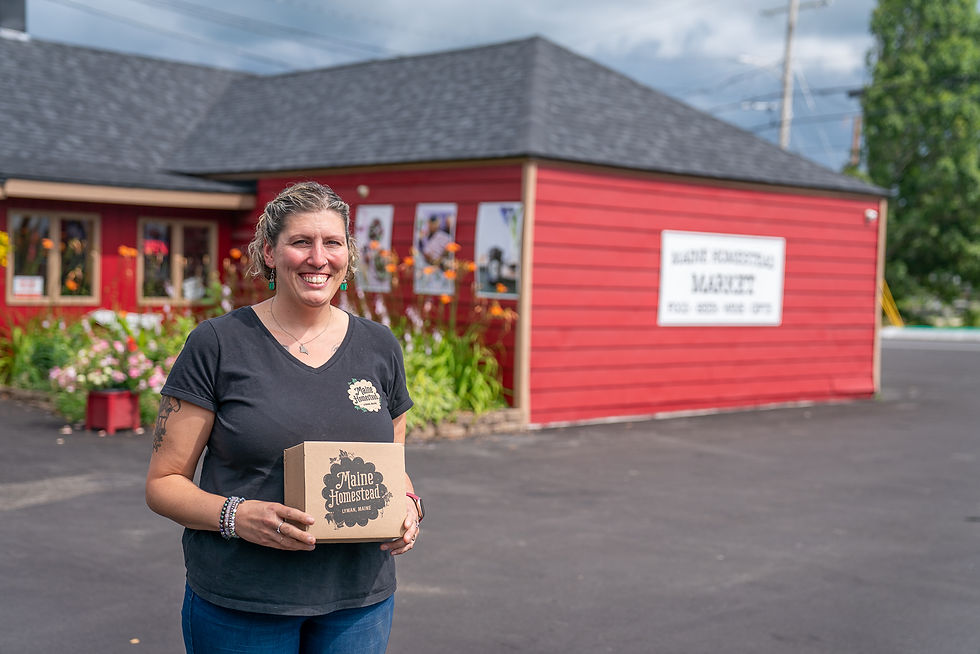
In 2016, Gagne found a property on Kennebunk Pond Road in Lyman. It had served as an RV dealership for approximately 30 years, and its garage offered a largely blank canvas for a commercial kitchen. Gagne and Brian purchased it in November 2016.
Her first project was creating what she imagined would be a small retail area for Maine Homestead products. The old building needed far more work than expected. Wiring had to be replaced, and the floors, walls and ceilings were rebuilt.
The little store also began growing beyond Gagne’s original plan.
Years of attending farmers markets had introduced her to producers from across Maine. She knew who made exceptional products, what customers responded to and which small businesses deserved a wider audience.
Maine Homestead Market became a place to celebrate them.
Maine Homestead Market Celebrates Maine-Made Products
The store now carries products from more than 200 local businesses, including Maine-made foods, meat, eggs, dairy products, craft beer and gifts. Some of the makers have known Gagne since they stood together beneath tents at farmers markets.
“We’ve always sold exclusively local beer,” Gagne said. “Frankly, it’s super easy because Maine has so many craft breweries.”
The relationships extend in both directions. Maine Homestead products are sold in hundreds of other stores, while the Lyman market creates shelf space—and now online space—for other Maine businesses.
Today, Maine Homestead has three interconnected identities. It is a food producer making approximately 27 different products, a neighborhood market serving residents and visitors, and a growing e-commerce operation shipping Maine-made goods far beyond the state.
Gagne once assumed the Lyman location would primarily attract local residents. Instead, vacationers staying around the area’s many ponds began discovering it, too.
“If you’re on vacation and you find this cute little store, it’s like your vacation store,” she said. “They’re coming here every day. They’re really excited about it.”
The discovery reinforced something Gagne learned during years of watching visitors in places such as Kennebunkport. People come to Maine because they value what makes it distinctive. They want to experience local places and bring part of that experience home.
“I appreciate that I live somewhere that other people want to come on vacation,” Gagne said. “It’s a nice spot.”
Shipping Maine Products Across the Country—and Beyond
Maine Homestead’s online customers now purchase far more than the company’s pickles, jams and relishes. Gagne said approximately half of its website orders contain none of Maine Homestead’s own products.
One recent shipment consisted of three packages of Maine-made catnip headed to Florida. Other orders combine foods and gifts produced by several of the small Maine businesses represented in the store.
Maine Homestead’s own products have traveled even farther. The company once received a wholesale order from a beauty shop in Australia after the buyer discovered it through an online wholesale marketplace. Customers have also told Gagne about sending Maine Homestead products to Italy, Japan, Puerto Rico and other destinations around the world.
The name has helped the company capture something meaningful to people who live here, visit here or simply love the idea of Maine.
“We have a very Maine brand,” Gagne said. “People who like Maine, or like the idea of Maine, like it for that reason as well.”
Locally, however, some customers now associate Maine Homestead more closely with the market than the products that created it. Gagne discovered this when a University of Maine intern surveyed customers about what they wanted the company to make next.
Gagne expected suggestions for new pickles or jams. Instead, customers recommended products they wanted the market to carry.
It was the first time she realized that the public’s idea of Maine Homestead had grown beyond her own.
Maine Wild Blueberry Jam Becomes the Bestseller

Maine Homestead’s best-selling product is its Maine wild blueberry jam. The company sells approximately twice as much blueberry jam as any other item it produces, using wild blueberries sourced from the Passamaquoddy Tribe.
Although blueberry jam now seems like a natural product for a company called Maine Homestead, Gagne initially hesitated to add it. Wild blueberries were expensive, and she did not know whether customers would pay the price required to make the product sustainable.
Learning how to price products has been one of the challenges accompanying the company’s growth. Maine Homestead now carries the cost of its property, production equipment, vehicles, employees, large coolers and an electricity bill exceeding $2,000 a month.
Gagne has learned that producing and selling more does not automatically make everything less expensive. Maine Homestead is large enough to require substantial infrastructure but not large enough to purchase every ingredient by the truckload.
Its presence in approximately 850 stores may create the impression of an enormous manufacturer. Behind the brand, however, is a Maine small business carefully balancing production, payroll, distribution and the cost of every ingredient and jar.
From Studying Entrepreneurship to Building a Maine Business
Although Maine Homestead began unexpectedly, Gagne’s desire to build something of her own did not.
Her father worked independently in construction for much of her childhood. Gagne remembers leaving school during the day for appointments and being fascinated by all the people she saw out in the world. She had assumed everyone would be at work.
“I want to be an out-during-the-day kind of person,” she remembered thinking. “I want to be self-employed and doing stuff.”
Gagne graduated from high school a year early and enrolled at Thomas College in Waterville, where she studied entrepreneurship and small-business management. She did not want to prepare for a career inside a large corporation. She wanted to learn how to build something that belonged to her.
She graduated from college early, too, earning her degree in 2007.
“I just really wanted to do stuff and get out,” she said.
Before Maine Homestead, she cleaned houses, cared for pets and worked as a personal assistant. She pursued opportunities wherever she found them.
“I’ve got a lot of hustle,” Gagne said.
Maine Homestead became the place where her education, energy and instincts came together.
“This was just the thing that I liked to do and other people wanted,” she said.
Building Maine Homestead One Jar at a Time
Maine Homestead now employs approximately 20 people. Its growth is visible in the inventory, boxes awaiting shipment, cases stacked inside the warehouse and steady activity inside the retail store.


It is also visible in the company vehicles. One license plate reads “PCKLED.” Another reads “JAMVAN.”
The plates are playful, but they represent a company that has retained its personality while growing far beyond Gagne’s first table at a school harvest festival.
The scale can be deceptive. Eight hundred and fifty retail locations and 100,000 jars a year sound like the numbers of a large manufacturer. Yet the jars are still filled by people, and many of the products are still delivered by the same family that helped establish Maine Homestead at farmers markets.
Gagne’s father, Tim, still helps with deliveries, often making them before reporting for third-shift work at Portsmouth Naval Shipyard. She described him as especially well suited for talkative customers because he enjoys visiting new places and rarely rushes through a conversation.
Her mother remains an important part of Maine Homestead, too. She helps with bookkeeping and provides a patient ear when Gagne needs to talk through the many frustrations, decisions and moving parts that come with running a growing business.
Her family is no longer staffing 16 farmers markets a week, but its presence remains woven throughout the company. It can be found in her grandfather’s cucumbers, her grandparents’ basement, her father making deliveries before work, her mother balancing books and listening to the occasional rant, and the countless early days when everyone helped Maine Homestead keep moving.
Gagne is quick to acknowledge that support and the good fortune that helped the business grow. But luck did not wake before work to make jam. Luck did not clean houses between farmers markets, fill a school with cooling jars or turn a worn RV dealership into a production facility and thriving retail store.
Krista Gagne did those things.
From One Batch of Pickles to 100,000 Jars a Year
Gagne still finds it difficult to comprehend how far Maine Homestead has traveled from that first batch of bread-and-butter pickles.
“Anytime I sit and think about it, we’ve made so many jars over the course of the business,” she said. “If you have a jar of something in your house, it’s probably more than just you who’s eaten it. So thinking about how many people have eaten something that we’ve made is really crazy.”
Today, Maine Homestead produces approximately 100,000 jars a year, with products sold in about 850 stores across the country. Some have traveled much farther, carried or shipped by customers to family and friends around the world.
But every one of those jars can be traced back to something wonderfully small: a grandfather’s garden, an abundant cucumber crop and a granddaughter who refused to let any of it go to waste.
Many thanks to Krista Gagne for her time on Thursday, July 30, 2026 in Lyman, Maine. Interview and photos by Cy Cyr.
Visit Maine Homestead online: https://www.mainehomesteadmarket.com
Visit Maine Homestead Market at 1773 Alfred Road, Lyman, Maine 04002-7792
BrickTides.com celebrates the people, businesses and ideas shaping life along the coast of southern Maine. Subscribe to discover more independently produced stories and photography from the communities we call home.